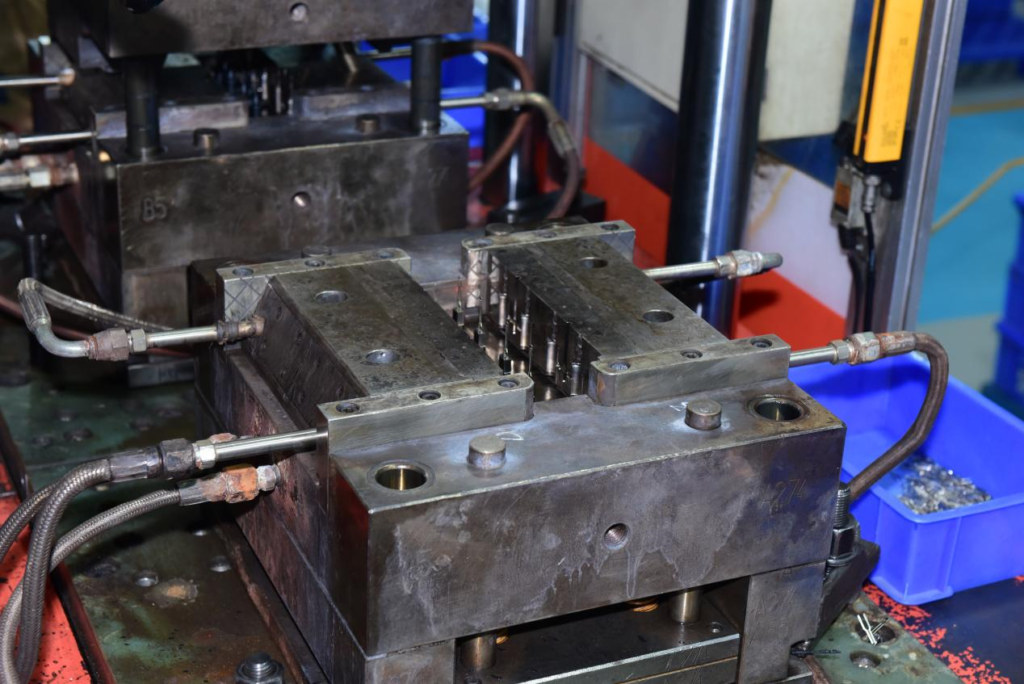
For Tier 1 automotive and industrial sensor buyers, purchasing a high-precision injection mold is an investment in long-term reliability. When producing complex sensor housings and connectors, you need tooling that guarantees dimensional consistency, zero-leakage performance, and a mold lifespan that spans millions of cycles.
However, sensor components frequently use engineering plastics reinforced with glass fibers (such as PA66-GF30) to meet strict thermal and mechanical demands. During injection molding, these materials present two critical challenges: severe abrasive wear on the tooling and warpage caused by uneven thermal contraction.
At E-TECH, we eliminate these risks during the engineering phase through application-specific mold steel selection and meticulous 2D DFM (Design for Manufacturability) cooling channel layouts. Here is a look behind our process.
Fighting Tool Wear: Matching Premium Steels to Critical Mold Components
Glass fibers act like “micro-sandpaper” under high temperature and injection pressure. If a mold is constructed from standard, low-grade tool steel, the cavities will quickly wear down, leading to heavy flashing (burrs) and dimensions that gradually drift out of tolerance.
To ensure our molds withstand high-volume production without dimensional drift, we match every critical component with the industry’s most reliable high-grade steels:
S136 (Corrosion & High-Cosmetic Cavities): For sensor housings with high aesthetic requirements and strict corrosion resistance needs, we utilize S136. Its exceptional polishability ensures flawless surface finishes, and its rust prevention properties protect the mold face in humid production environments.
SKD61 & 8407 (High-Heat & Fiber-Reinforced Cavities/Cores): To withstand high melt temperatures and the intense abrasive rush of glass-fiber-filled resins, we employ SKD61 and 8407 hot-work tool steels. These steels offer outstanding thermal shock resistance and high-temperature strength, preventing thermal cracking over hundreds of thousands of cycles.
DC53, S7 & SKH-9 (High-Stress Inserts & Micro-Core Pins): Sensor connectors feature extremely fine terminal slots and micro-pins.
We use S7 for its superior shock resistance, ensuring delicate core pins do not snap under intense injection pressure.
For micro-inserts and sliding parts subject to constant frictional wear, we select DC53 and SKH-9 (High-Speed Steel) to guarantee they never deform, chip, or wear down, keeping micro-level tolerances locked in across all cavities.
Preventing Warpage: “One Core, One Cycle” Independent Cooling Layout
Sensor housings and connectors are geometrically complex, often with highly uneven wall thicknesses. During the cooling phase of the injection cycle, if one section of the mold cools faster than another, the uneven thermal contraction forces the plastic part to warp, twist, or shrink unevenly. A warped housing compromises the tight fit of the final assembly, leading to a failure in leak-free performance.
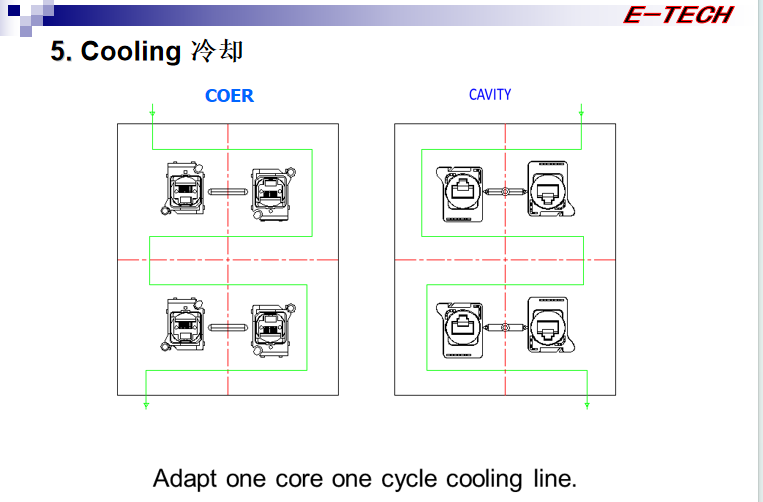
We address this thermal imbalance in the 2D DFM phase by engineering independent cooling circuits for both sides of the mold.
Case Study: E-TECH DFM 2D Cooling Layout
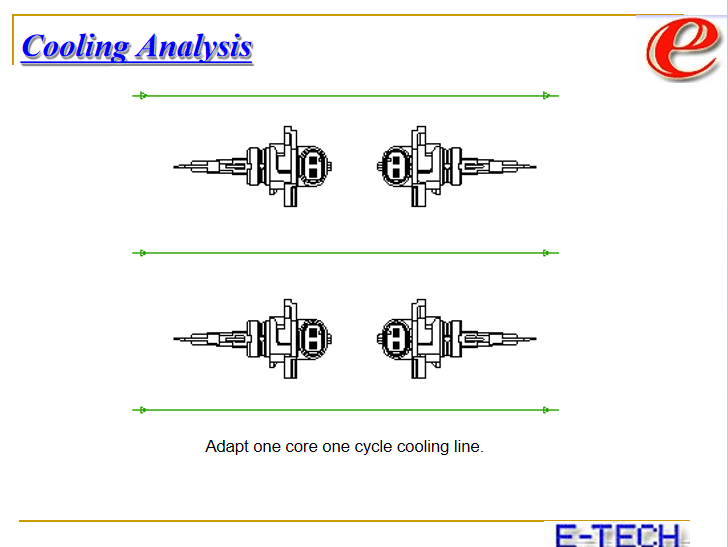
CORE & CAVITY Independent Routing: As shown in our DFM layout above, we design separate, dedicated cooling channels for the CORE (internal geometry, which usually traps heat) and the CAVITY (external cosmetic geometry).
The “One Core, One Cycle” Flow: Instead of routing cooling water in a lazy, single-loop path that loses cooling efficiency halfway through, we utilize a “one core, one cycle” cooling line loop. The water enters, circulates directly around the molding area of each individual cavity, and exits efficiently.
The Result: This balanced, symmetrical routing keeps the mold temperature gradient tightly controlled. Because the plastic cools and solidifies at an identical rate across all surfaces, residual stress is virtually eliminated. This prevents part warpage, reduces cycle times by 15% to 25%, and guarantees that every connector achieves a perfect, airtight fit.
Uncompromising Consistency in Multi-Cavity Production
For Tier 1 automotive programs, maintaining strict dimensional consistency across multi-cavity molds (such as 4-cavity or 8-cavity setups) is paramount.
By pairing our rigorous cooling channel design with precise manufacturing tolerances (within plus or minus 0.02 mm for injection molding), we ensure that Cavity 1 and Cavity 8 produce identical parts. This level of engineering control allows our clients to maintain a process capability index (Cpk) greater than 1.67, ensuring seamless assembly and zero defects on the production line.
Partner with E-TECH for Precision Tooling
At E-TECH, we believe true precision starts on the drawing board. By selecting the optimal tool steels—from S136 to SKH-9—and backing them up with engineered, balanced cooling designs, we deliver robust tooling that protects your product quality and your bottom line.
Are you developing a new sensor housing or connector project? Contact our engineering team today to receive a professional DFM and moldability evaluation for your design.